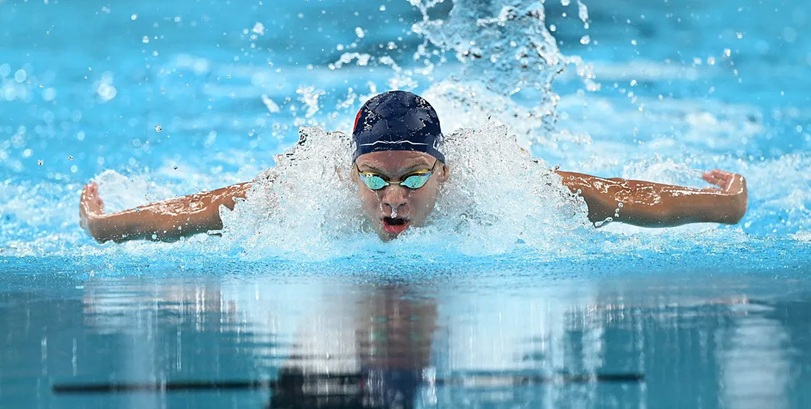
World Aquatics has officially begun construction of its new global headquarters in Budapest, marked by a foundation stone ceremony on October 7, 2025. The facility, financed by private developer Southblaze Ltd., will bring together administrative offices, an elite training centre and athlete accommodation within a 20,000-square-metre complex. This move reflects an institutional strategy to modernise sports governance and decentralise international operations away from traditional hubs such as Lausanne.
The choice of Hungary is no coincidence. The country is a historic powerhouse in aquatic sports, producing champions like Katinka Hosszú, Kristóf Milák, Dániel Gyurta and László Cseh, whose achievements have elevated Hungary’s reputation on the global stage. Budapest has also hosted the World Aquatics Championships in 2017 and 2022, strengthening its status as a premier venue for international competition. The project has the backing of the Hungarian Government, the Municipality of Budapest and District 13, where the complex will be located, aligned with the city’s Budapest 2030 urban development plan and its sustainability goals.
A strategic and symbolic move
The relocation from Lausanne was approved at the 2023 General Congress, and since 2024, World Aquatics has been operating partially from an interim office in Budapest. The federation aims to centralise its administrative, technical and educational divisions in one location while strengthening collaboration with universities and sports science institutions. “The new headquarters reflects our vision of a more global, sustainable and inclusive sport,” said Husain Al-Musallam, president of World Aquatics, during the inauguration ceremony.
The new building, which blends contemporary architecture with traditional Hungarian design elements, symbolises the connection between the country’s aquatic heritage and the federation’s international vision. World Aquatics intends for the headquarters to serve not only as an administrative base but also as a meeting point for athletes, coaches, officials and continental federations, establishing a more cohesive and modern operational structure.
Strategic goals and expected benefits
The project aims to enhance institutional efficiency, boost sports innovation and promote international cooperation in a facility designed for the 21st century. The creation of a multifunctional complex will optimise resources and provide a permanent base for training, research and technical events. At the same time, Hungary stands to benefit from a steady influx of conferences, competitions and visitors, driving urban and economic growth in District 13 under the “15-minute city” concept.
The symbolic impact is equally significant: with this decision, World Aquatics positions Budapest as the global centre of aquatic sports, reinforcing its reputation as a capital of excellence in swimming, water polo and diving. The federation also expects the project to inspire further international partnerships and attract other sports organisations to establish offices in the Hungarian capital.
International precedents
The decision by World Aquatics follows a wider trend among international sports federations seeking more integrated and community-oriented governance models. The Fédération Internationale de Football Association (FIFA) moved part of its operations from Zurich to Florida in 2023, while the International University Sports Federation (FISU) relocated its headquarters to the Lausanne university campus in 2018 to strengthen academic ties. However, the World Aquatics project stands out for combining an institutional relocation with the creation of a state-of-the-art architectural and urban complex.
The new headquarters is scheduled for completion by mid-2028. Through this initiative, World Aquatics aims to set a new benchmark in international sports management by integrating innovation, sustainability and historical legacy. Budapest, in turn, strengthens its position as the epicentre of global aquatic sport — a project that unites athletic ambition, urban development and institutional diplomacy.
 Last related articles