Rising stars, historic para victories, and international talent highlight a sport ready for the Olympic stage.
China celebrated a historic first at the 2025 World Games when Li Yucai and Guo Ao claimed the nation’s first-ever para ju-jitsu gold medal. Competing in the Mixed Duo Para Physical event, they narrowly defeated Germany’s Alessandro Schober and Christine Jahn 167–162. “Four months of intense training together proved our dedication to the sport,” Li said. The achievement highlighted not only China’s rising strength in ju-jitsu, but also the growing global recognition of para events.
Germany excelled as well, with Nike Hunecke and Julia Paszkiewicz winning the Mixed Duo Para Visual category, while Italy’s Giovanni and Pietro Napoli took gold in the Mixed Duo Para Mental event. Giovanni celebrated alongside his sibling Pietro, who has Down syndrome, saying, “He’s not different, just a little special. Carrying him to gold is my proudest achievement.”
The tournament, held from August 10 to 12 at Chengdu’s Jianyang Cultural and Sports Centre Gymnasium in China, brought together 129 athletes from 37 countries across 19 events, showcasing both traditional martial art and innovative adaptations. Since its World Games debut in 2013 in Cali, Jiu-Jitsu, also known as Brazilian Jiu-Jitsu, has steadily grown in popularity and international recognition.

World Games 2025
Israel’s Nimrod Ryeder emerged as a standout, claiming his second gold medal in the Men’s Open category, after previously winning the 77kg title. Hungary’s Tamara Toros defeated reigning champion Sung Ki-ra in the women’s 63kg semifinals, and went on to secure the women’s open gold. The United Arab Emirates also impressed, with Saeed Al Kubaisi taking gold in the under-85kg category, while Mehdi Al Awlaki and Mohammed Al Suwaidi earned silver in the under-77kg and under-69kg divisions.
In the Fighting disciplines, Ukraine’s Bohdan Mochulskyi achieved a third consecutive World Games gold in the men’s -62kg category, defeating the Netherlands’ Ecco Van der Veer 17–12. France’s Estelle Gaspard dominated the women’s -52kg division, while Denmark’s Rebekka Dahl earned silver in the women’s 57kg category, narrowly falling to Germany’s Sophie Busch in a closely contested final. Busch praised Dahl as a personal role model, saying, “It’s just amazing because Rebekka Dahl has always been my model when I was young. I never expected to defeat her in the final.”
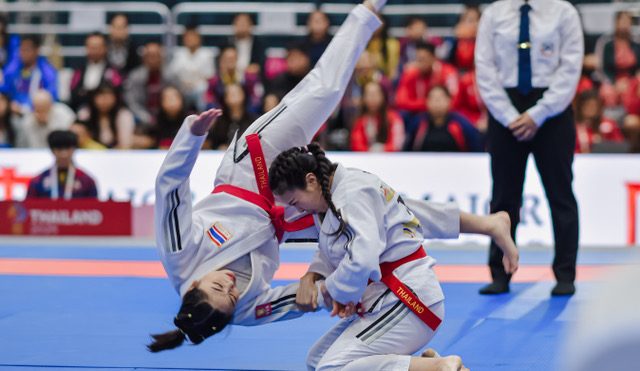
Thailand asserted dominance in both traditional and show formats. Warut Netpong and Charatchai Kitpongsri captured gold in the Mixed Duo Show Open category with acrobatic flair that impressed judges and spectators. Thailand also secured gold in the Mixed Duo Team Open event, followed by Austria and Italy, solidifying its status as a hub for traditional ju-jitsu excellence.
The World Games highlighted ju-jitsu’s universal appeal, with champions emerging from 14 nations including France, Korea, Kazakhstan, Belgium, and Denmark. Nearly 70% of participating countries earned at least one medal, reflecting the sport’s growing competitiveness. The inclusion of para ju-jitsu emphasized the sport’s commitment to inclusivity and its global vision.
 Last related articles